Introduction
What is the data integration gap? It is the gap between the data companies have and the data AI systems need. This gap is a central reason why so many AI projects in the manufacturing sector fail — not because the algorithms are bad, but because the data doesn't work.
The report from March 5, 2026 was sobering (thelec.net): In the manufacturing space, current sources report a success rate of only around 13%, despite cumulative global investments of approximately $127 billion in the period 2019–2024. According to coverage of a MICUBE analysis, "structural challenges in how industrial data is organized and interpreted" are among the central reasons.
For DACH companies in industry, this is an opportunity: whoever closes the data integration gap has a decisive competitive advantage.
The Study: What the Research Shows
Key Results
- Only ~13% of AI projects in manufacturing succeed — current sources show a dramatically low success rate in industrial manufacturing
- ~$127 billion cumulative global investment in manufacturing AI (2019–2024)
- A central reason: Not algorithms, but data quality — alongside other factors such as unclear problem definition and insufficient infrastructure
According to MICUBE Analysis
According to coverage of a MICUBE analysis, the structural challenges include:
- Data silos — data exists in isolated systems without connection
- Inconsistent formats — each system uses its own data formats
- Missing real-time capability — data isn't ready for real-time processing
- Quality problems — no standardized quality measurement
The 5 Most Common Data Integration Mistakes in AI Projects
1. Data Silos Not Resolved
The problem: Production data is in the ERP, quality data is in a separate system, maintenance data is in an Excel spreadsheet. The AI model only sees fragments of reality.
The solution: Rethink data architecture from the ground up. Identify all relevant data sources and connect them through a central integration layer.
2. No Unified Data Layer (Gold/Silver/Bronze)
The problem: Raw data is passed directly to the AI model without transformation or cleaning. The model learns from "dirty" data.
The solution: Build a multi-tier data model:
- Bronze: Raw data from source systems
- Silver: Cleaned, transformed data
- Gold: Business-ready data models for AI
3. Legacy Systems Not Connected
The problem: Old production systems, machine controls, legacy ERP — they contain valuable data but no modern APIs.
The solution: Integration via MuleSoft or comparable platforms. Modern integration can also connect legacy systems.
4. Data Quality Not Measured
The problem: No metrics for data quality. Missing values, duplicates, inconsistencies aren't detected.
The solution: Implement data quality monitoring:
- Completeness checks
- Consistency validation
- Automatic alerts for quality problems
5. Real-Time Data Access Not Planned
The problem: Batch processing instead of real-time. AI systems work with outdated data.
The solution: Stream-based architectures for time-critical applications. Apache Kafka, MQTT for IoT data.
| Mistake | Impact | Solution |
|---|---|---|
| Data silos | Incomplete model training | Central integration layer |
| No Gold/Silver/Bronze | "Dirty" data | Multi-tier data model |
| Legacy not connected | Data gaps | MuleSoft integration |
| No quality measurement | Unreliable results | Data quality monitoring |
| Batch only | Outdated predictions | Stream architecture |
Why Data Integration Comes Before AI
The Foundation Principle
Imagine a house: AI is the building above the foundation. Without a stable foundation, the house collapses. Data integration is the foundation — without functioning data architecture, no AI project can succeed.
The Architecture Logic
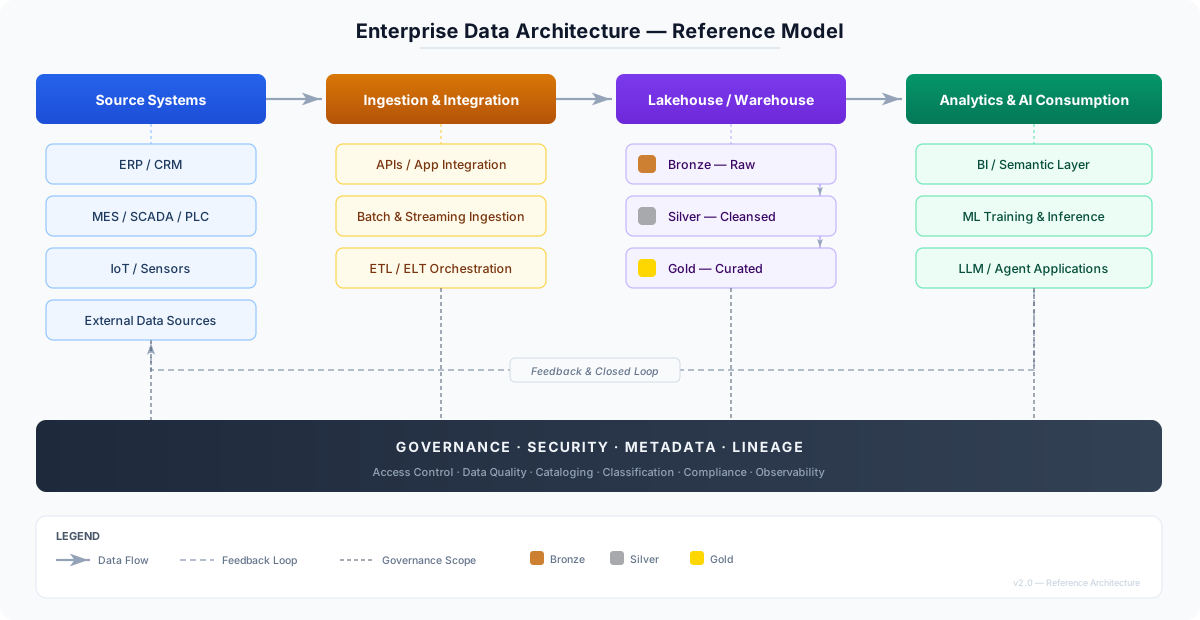
Each layer must work for the next to work.
Cost-Benefit Calculation
- Data integration is demanding: Data preparation and integration often make up a significant share of the effort in AI projects
- Result: Reliable, scalable AI solutions
- Alternative: High probability of failure — especially in the manufacturing context
Investing in data integration is insurance against AI failures.
DACH Practice Example: How a Project Was Saved Through Proper Data Integration
The Starting Point
A manufacturing company (anonymized practice example) wanted to implement a predictive maintenance system. Two previous attempts had failed:
- Attempt 1: Direct use of an ML model on ERP data → unreliable predictions
- Attempt 2: Excel-based data preparation → not scalable
The Ai11 Approach
- Inventory: All relevant data sources identified and consolidated
- Integration: Connection to ERP, PLC, and sensor systems through a central integration layer
- Data model: Gold/Silver/Bronze layers built
- Quality assurance: Automatic data quality checks implemented
- First ML model: Trained with clean data
The Result
- Reliability: Significantly improved prediction accuracy
- ROI: First savings through avoided downtime within a few months
- Scalability: System successfully rolled out to additional production lines
The realization: The next attempt worked — because data integration was finally set up correctly.
The Ai11 Approach: Integration-First AI Strategy with MuleSoft
Our Framework
Phase 1: Data Audit (2-3 weeks)
- Inventory of all data sources
- Assessment of data quality
- Identification of integration gaps
Phase 2: Architecture Design (2-4 weeks)
- Define multi-tier data model
- Establish integration patterns
- Plan MuleSoft connection
Phase 3: Implementation (6-12 weeks)
- Develop MuleSoft flows
- Implement data quality monitoring
- Train first AI models on clean data
Phase 4: Operation & Optimization (ongoing)
- Performance monitoring
- Continuous quality improvement
- Scaling to additional use cases
Checklist: Is Your Data Architecture AI-Ready?
Data Sources
- All relevant data sources identified
- APIs or integration methods for each source available
- Data protection (GDPR) considered
Data Quality
- Data quality metrics defined
- Automatic quality checks implemented
- Escalation processes for quality problems
Data Architecture
- Bronze/Silver/Gold layers defined
- Data model meets business requirements
- Scalability for future use cases planned
Integration
- MuleSoft or comparable integration active
- Real-time and batch paths available
- Error handling and recovery mechanisms
Conclusion: Data First, AI After
The numbers from industry are sobering: in the manufacturing context, current sources report only around 13% of AI projects succeeding. But it doesn't have to be that way. A central reason for many failures isn't the model — it's data integration.
For DACH companies, this means:
- Invest in data first — before you train a single model
- Build a foundation — with Bronze/Silver/Gold layers and a robust integration layer
- Measure quality — from the start, not after the fact
Companies that understand this will lead the AI revolution in industry. The others risk joining the ranks of unsuccessful projects.
Ready to close the data integration gap? Contact us for a data audit.