MuleSoft in 2026
MuleSoft, part of Salesforce since 2018, has established itself as the standard platform for enterprise integration. According to MarketsandMarkets, the global API management market is projected to reach $127 billion by 2028 — driven primarily by the demand for AI-ready infrastructure.
The critical connection is straightforward: AI agents can only work as well as the data they can actually reach. Without a robust integration layer, agents remain isolated, access incomplete information, and produce unreliable results. This is exactly where MuleSoft becomes a critical component. The platform not only connects systems but creates the foundation for agents to interact with enterprise data, processes, and actions in a controlled way.
This is particularly relevant for organizations in the DACH region, where many companies work with historically grown system landscapes. ERP, CRM, service tools, databases, and custom legacy systems have often developed over years. An AI agent in such an environment will only be productive if data flows, authentication, and transformation are handled cleanly from a technical standpoint.
New Features 2026
Looking ahead to 2026, it becomes clear that MuleSoft is not only addressing classic integration requirements but expanding more strongly toward agentic use cases. This applies especially to API design, governance, and handling new interface standards for AI systems.
A central theme is the AI Assistant for API Design. MuleSoft introduces an AI-powered assistant in 2026 that supports developers with API development. This includes automatic API generation from documentation or OpenAPI specifications, best practice suggestions for optimizing endpoints and payloads, and security scans that automatically detect potential vulnerabilities.
Governance is also becoming more automated. A new framework is designed to help manage API quality, compliance, and lifecycle management more systematically:
| Feature | Description |
|---|---|
| API Quality Scores | Automatic assessment of API quality |
| Compliance Checks | Automatic verification of standards |
| Lifecycle Management | Automated deprecation processes |
Additionally, Anypoint Exchange receives updates. The API marketplace is expanding with features particularly relevant for AI-oriented architectures. These include AI-Ready Asset Categories for AI-optimized APIs, Model Context Protocol Support for direct integration with MCP clients, and ML Model Versioning specifically designed for model APIs.
API-First for AI Agents
Why APIs Are Essential
According to Gartner/VentureBeat (2022), 87% of AI projects fail not due to the algorithms, but due to poor data integration. This is precisely why API-First in the context of AI agents is not a technical detail but a strategic prerequisite.
AI agents differ fundamentally from classic applications in several ways:
| Aspect | Classic App | AI Agent |
|---|---|---|
| Data Access | Predefined | Dynamic |
| Decisions | Programmed | Context-based |
| Workflows | Linear | Adaptive |
| Error Handling | Static | Learning |
Agents therefore need flexible, standardized access to enterprise data. APIs are the link — provided they are designed for machine clients. An API built for human-facing frontends is not automatically suitable for agents. What matters are understandable descriptions, consistent data models, controllable access paths, and clean error handling.
MCP: The New Standard
The Model Context Protocol (MCP) is becoming the de-facto standard for AI agent integration. The reason lies in standardization: agents should no longer need to individually "know" each integration, but instead interact with tools and APIs through uniformly described capabilities and contexts.
At its core, MCP brings three things:
- Standardized Communication: one protocol for different agents
- Tool Discovery: agents automatically recognize available tools
- Context Sharing: contextual information is shared automatically
MuleSoft supports MCP natively from 2026. A simplified example of such an endpoint:
{
  "mcp_endpoint": "https://api.company.com/mcp",
  "capabilities": ["read", "write", "transform"],
  "authentication": "oauth2"
}
This is relevant for enterprises because APIs can be made not only technically available but also semantically clearer for agents. This facilitates orchestration, governance, and reusability.
Architecture Patterns
Pattern 1: Agent as API Consumer

The agent uses MuleSoft as an API layer to access enterprise systems in a controlled way, reading data or executing actions.
Pattern 2: Event-Driven Agents

Here MuleSoft processes an event from the system landscape and automatically triggers the appropriate agent workflow based on it.
Pattern 3: Agent Orchestration
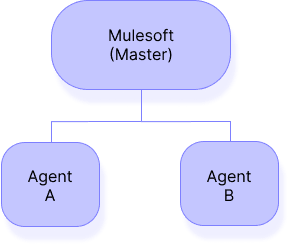
In more complex scenarios, MuleSoft coordinates multiple specialized agents within a shared workflow.
A critical practical point is often less the model itself than the data transformation layer. Many problems arise exactly there: different data formats, missing fields, or inconsistent authentication lead to agents receiving faulty or incomplete contexts. A clean API layer with a unified data model is therefore usually the most important investment before the first agent pilot.
Best Practices for DACH Companies
1. API Design for Agents
Self-describing APIs are not a nice-to-have in the agentic context — they are mandatory. Agents should be able to understand APIs as automatically as possible. OpenAPI specifications with meaningful descriptions are therefore central. Equally important is Semantic Versioning so that updates do not disrupt running agent-based clients. Add to this Rate Limiting: resource consumption by agents must be limited and monitored early, because uncontrolled agent loops can quickly overload APIs.
2. Security
Even internally: every API call must be authenticated and authorized. Zero-Trust is therefore relevant for agents as well. For machine authentication, OAuth 2.0 in the Client Credentials flow is more appropriate than shared user tokens. Additionally, Audit Trails should fully log all agent actions to ensure compliance, error analysis, and later traceability.
3. Monitoring
In production, classic API metrics are not sufficient. Companies should track agent-specific KPIs such as success rate, error rate, and response times per agent separately. Running agents are particularly sensitive to API latency, which is why alerting from 500 ms can make sense. Equally important is cost analysis, as API calls by agents incur ongoing costs that should be made visible per use case.
Integration with Salesforce
MuleSoft + Agentforce
The combination of MuleSoft and Salesforce Agentforce is becoming the standard because it connects operational systems, data preparation, and agentic execution. In practice, this typically runs in four steps:
- Data Extraction: MuleSoft fetches data from legacy systems
- Transformation: Data is prepared for agents
- Action: Agentforce executes actions
- Synchronization: Results are written back into systems
Data Cloud as Middle Layer
Salesforce Data Cloud plays an additional role. In many architectures, it serves as the central data store for agents and reduces direct dependency on legacy systems.
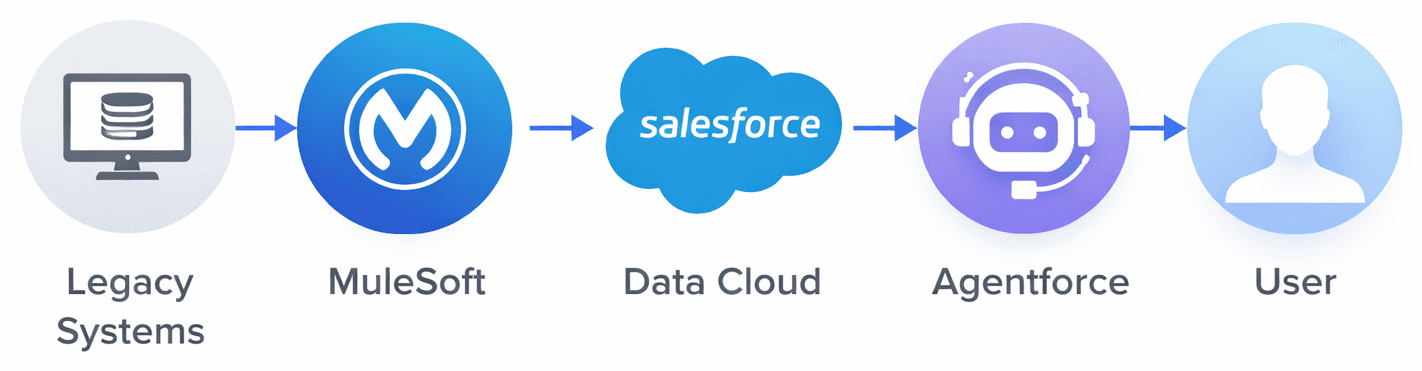
This creates a cleaner architecture: MuleSoft handles the connection and transformation of operational systems, Data Cloud consolidates relevant data, and Agentforce accesses prepared information on this basis. For organizations with heterogeneous landscapes, this is often significantly more robust than connecting each agent directly to multiple legacy systems.
Case Study: DACH Mid-Market
An Austrian machinery operator wanted to optimize its maintenance processes with AI. The starting situation was technically demanding:
- 50+ legacy systems
- 200+ different APIs
- Core data sources: SAP, Oracle, SQL Server
The first pilot agent initially delivered unreliable results in the first few weeks — not because of the model, but due to inconsistent data formats between SAP and Oracle. Only after cleaning up the data mapping layer in MuleSoft did the predictions stabilize. This phase took approximately four weeks and was critical to the later success of the project.
The solution consisted of three building blocks: API standardization via MuleSoft as the central API layer, Agent-Ready APIs for all critical interfaces, and a clearly defined pilot use case around a maintenance agent.
| Metric | Before | After |
|---|---|---|
| Average repair time | 48h | 12h |
| Problem detection | Reactive | Proactive (24h in advance) |
| API calls per day | 1,000 | 50,000 |
These numbers show that the real lever is not first in the model, but in the quality of the integration and transformation layer. Only through this does an experimental AI agent become an operationally reliable system.
Conclusion
MuleSoft in 2026 is more than an integration platform — it is the technical foundation for productive AI agents in enterprise environments. Companies investing in API-first structures now significantly reduce the risk costs of future AI projects.
For DACH companies, this leads to three clear recommendations: Existing APIs should be reviewed in an API audit for agent readiness — particularly regarding documentation, data model, and error behavior. In parallel, it is worth preparing for MCP early, before the first production agent goes live. And finally, the first productive deployment should consciously be limited to a clearly defined, well-documented pilot use case.
Want to make your APIs agent-ready? In a 2–3 week architecture audit, we analyze your existing integration landscape, identify gaps, and define concrete next steps for an AI-ready API layer.
Contact us — we'll help you establish MuleSoft as the foundation for your AI agents.