Salesforce unveiled Headless 360 on April 15, 2026, with a message deliberately framed larger than an ordinary release: "Everything on Salesforce is now an API, MCP tool, or CLI command." Under this announcement, Salesforce bundles more than 60 new MCP tools and over 30 pre-configured coding skills, a new Experience Layer for interactions across different surfaces, and capabilities for testing, observability, and A/B testing of agents.
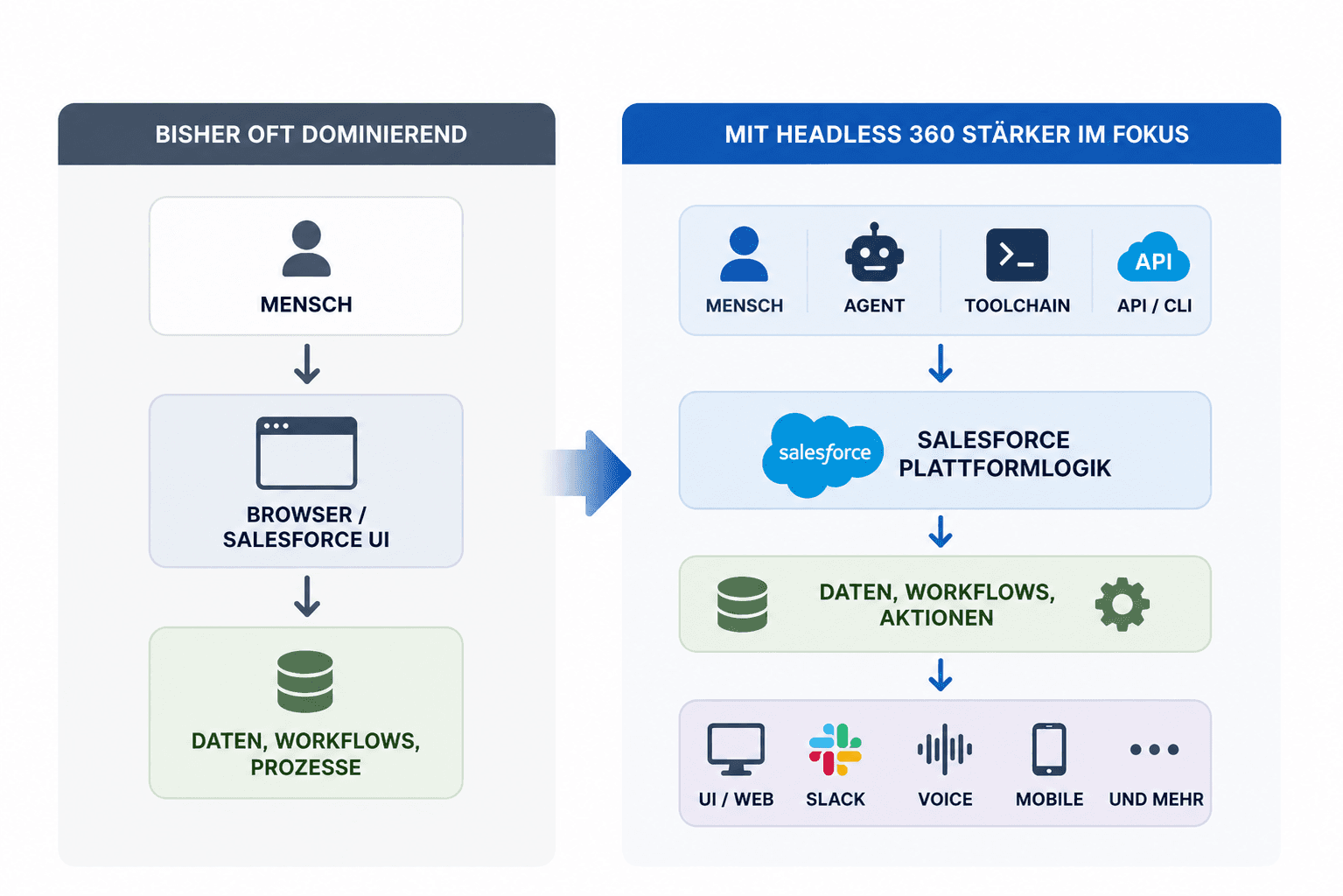
The real shift is not that the Salesforce interface disappears. It is that it loses its status as the natural centre. For many years, Salesforce was always also a platform, but operationally it was primarily an application: people worked in the browser, clicked through processes, configured workflows in the interface, and viewed APIs as an extension. Headless 360 shifts this emphasis. Salesforce now describes the platform in a way that humans and agents can work with the same data, workflows, and Trust Layer, while only the surface changes. The UI remains important, but it is no longer the bottleneck through which every capability must be accessed.
What Headless 360 Is Actually About
The shortest meaningful reading is this: Salesforce is becoming more of an executable platform layer, not just an application in which people work.
This is more than a technical detail. In a classical CRM logic, Salesforce is primarily the system in which people execute processes. In a headless and agentic logic, Salesforce becomes more the system with which other systems, developer tools, and agents work directly. This changes not only technical processes but also the operating model.
This is where new questions arise: Who is allowed to call which capabilities? Which actions need to be tested? How are agentic calls logged? And how does one remain traceable when something no longer happens through a visible screen? These questions are not only relevant for developers. They affect admins, architects, platform teams, and everyone who integrates Salesforce into enterprise processes.
Why Headless 360 Is More Than a Developer Release
Salesforce addresses Headless 360 strongly through developer and builder workflows. But the effect extends beyond classical development. When capabilities are available as APIs, MCP tools, or CLI commands, they can be embedded more directly into integration layers, development environments, automations, and agentic workflows. Salesforce thereby becomes more of an executable capability layer in the enterprise stack.
Anyone thinking about AI agents, integration architecture, or platform governance today must no longer classify Salesforce merely as a frontend application, but as a platform whose capabilities become accessible and executable across multiple channels.
What Changes as a Result
| Previously more UI-centric | With Headless 360 more platform-centric |
|---|---|
| Work primarily happens in the browser | Work can also be triggered via APIs, MCP, CLI, and agents |
| The UI is the standard access point | The UI is just one of several access points |
| Changes are often visible and manual | Changes more frequently run via tools, pipelines, or agentic calls |
| Governance often appears role- and mask-based | Governance must be enforced more technically |
This shift is the real point. It is not just about new tools for developers, but about a new operational reading of the platform.
What Shifts in Practice
In practice, Headless 360 shifts three main areas.
First, access to the platform becomes more programmatic. When Salesforce capabilities are available as APIs, MCP tools, or CLI commands, they can be integrated more directly into development and operations workflows. This affects not only classical integrations but also agentic workflows in which tools and systems interact more autonomously.
Second, the interface becomes more decoupled. With the Experience Layer, Salesforce describes a UI layer that should enable interactions via Slack, Voice, WhatsApp, and other surfaces, without business logic remaining tied to a single screen. For users, interaction can still appear simple. Technically, execution moves deeper into the platform.
Third, operations move more strongly toward control and quality assurance. Testing Center, Session Trace OTel API, and A/B Testing API show that Salesforce is treating the productive operation of agents not just as a build topic, but also as a governance and observability topic. This point is particularly important because agentic systems not only deliver answers but increasingly call platform capabilities, modify data, or trigger processes.
This sounds technical at first, but it has a clear management dimension. Once a platform is no longer primarily used through the browser, the question of how it is controlled automatically changes. In a UI-centric world, many interventions are visible, manual, and role-based. In a headless world, the same interventions increasingly run via tools, pipelines, agents, or APIs. This does not automatically increase risk, but it shifts it: away from visible surface interaction, toward permissions, tool approvals, test coverage, monitoring, and auditability.
Why MCP Is the Critical Lever Here
A central reason Headless 360 is becoming relevant right now is the timing around MCP. The Model Context Protocol was introduced by Anthropic in November 2024 as an open standard to standardise secure, bidirectional connections between data sources, tools, and AI applications. Salesforce is now visibly adopting this standard and providing more than 60 MCP tools via the Salesforce DX MCP Server.
This lowers the barrier to embedding Salesforce capabilities into agentic development and operations workflows. Instead of connecting every piece of logic through proprietary individual integrations, MCP-capable clients can address standardised tools provided by Salesforce. This is more than another connector. MCP changes how an agent or coding assistant accesses capabilities.
Salesforce itself states that coding agents thereby gain live access to platform capabilities, data, workflows, and business logic, including in environments such as Claude Code, Cursor, Codex, or Windsurf. From a business perspective, the discussion shifts. The question is no longer just whether Salesforce can be technically connected. The more important question is which capabilities are granted to which agentic systems under which rules.
This is where a developer feature becomes a governance topic. Once an agent can not only read but also trigger actions, a technical connection is no longer sufficient. Then clear permissions, controlled tool approvals, tests, logging, and traceable responsibilities are needed.
Not Everything Is Already a Final State
Despite all strategic significance, Headless 360 should be assessed soberly. The Salesforce DX MCP Server is marked as Beta in the official documentation. Further agent-related capabilities are at different maturity levels depending on the component. Headless 360 is therefore not a fully completed target architecture that will stand ready in production in every organisation tomorrow.
For companies, this exact distinction is important:
- Strategically, the direction is clear: Salesforce is opening the platform more strongly for agents, APIs, CLI workflows, and new surfaces.
- Operationally, one must still carefully examine which components can be reliably used in production today and which capabilities should first be tested in a controlled manner.
The right reading is therefore neither hype nor resistance. Headless 360 is not cosmetic product branding, but neither is it an immediately finished operating architecture for all use cases.
The Browser Remains, But It Loses Its Exclusivity
When Salesforce no longer happens only in the browser, the logic of work changes on multiple levels. Development work moves closer to CI/CD, local or cloud-based IDEs, and versioned processes. Tests can be initiated from CLI or AI-assisted development environments. Deployments and quality checks can be more strongly integrated into delivery processes.
At the same time, the interplay of roles changes. The classical separation was often relatively clear: admins configure, developers extend, architects design, business units work in the UI. In a headless logic, these roles do not disappear, but they interlock more closely. Admin competence remains central because data model, permissions, and process logic continue to form the foundation. At the same time, architecture, security, and integration competence gain importance because the same capabilities become accessible through more channels and partly without direct human UI interaction.
This is not a devaluation of the admin role. Rather, the interplay between admins, developers, and architects becomes more important. Salesforce addresses these groups together in the Headless 360 positioning for a reason. When platform capabilities become accessible via agents, APIs, CLI, and various surfaces, the operating model must also reflect this reality.
Which Questions Are Now on the Table
For Salesforce teams with ongoing AI initiatives, Headless 360 becomes relevant above all where agents are meant to use production platform capabilities. Then general AI guidelines are no longer sufficient. Operative answers are needed for very specific questions:
- Which MCP tools or agentic capabilities are allowed in which environment?
- Which permissions apply to agents, toolchains, and development environments?
- Which tests block a deployment?
- Which actions are logged?
- Which session traces are exported and evaluated?
- Who intervenes when an agent repeatedly triggers incorrect or risky actions?
These questions do not arise first in implementation. They belong in the operating model. Salesforce is visibly moving in this direction with Testing Center, Custom Evaluations, Conversation-Level Testing, Session Trace, and A/B Testing. This brings architecture and operations closer together.
For companies using Salesforce strategically, this means: CRM governance and AI governance can no longer be considered separately going forward. Once agents access data, workflows, and platform logic, governance becomes not just a policy question but a technical control question. This is precisely where one of the most important points of Headless 360 lies.
The Real Question for Salesforce Teams
Headless 360 is relevant above all because it makes an existing development visible: Salesforce is no longer used only where a human opens an interface. The platform is increasingly addressed via APIs, tools, agents, CLI workflows, and embedded surfaces. This changes not only access but also responsibility for that access.
For Salesforce teams, it is therefore not sufficient to consider Headless 360 merely as a new collection of developer capabilities. What becomes decisive is which platform capabilities are released via which channels, how this usage is tested, and who retains control in operations. The more actions take place outside the classical UI, the more important permissions, observability, approval processes, and clear responsibilities become.
The central question is therefore not whether the browser disappears. It will not. The more relevant question is whether one's own operating model is prepared for Salesforce to be operated in the future not only by humans in the browser, but also by agents, toolchains, and APIs. It is precisely at this point that it is decided whether Headless 360 is perceived merely as another release or as an occasion to reconsider Salesforce governance, AI governance, and integration architecture together.